In 2026, “personalization” isn’t about adding more messages or more moments. It’s about making the stay feel effortless: fewer lines, fewer questions, fewer repeats—and more relevant options that appear exactly when guests need them.
That shift matters for guest satisfaction, but it’s also one of the most reliable ways to grow revenue without raising rates. When guests feel understood, they’re far more likely to say yes to room upgrades, late checkout, breakfast, parking, F&B, spa, and local experiences—especially when those options are presented through smooth digital touchpoints instead of manual selling.
Below are six practical ways to build a personalized guest experience that scales—and naturally drives ancillary revenue.
1) Personalize around “moments that matter” across the guest journey
Hotels often think personalization means knowing more about the guest. In practice, it’s just as powerful to personalize when and where you show relevant choices.
In 2026, the best guest journeys are designed around decision points:
- After booking (confirming plans, reducing uncertainty)
- Before arrival (preference capture, convenience add-ons)
- Arrival (speed and reassurance)
- In-stay (timely, useful options)
- Pre-departure (last-mile convenience)
- Post-stay (relationship + future intent)
When you design personalization around these moments, you’re not “adding marketing.” You’re reducing friction and making it easier for guests to choose what improves their stay.
What to do this week: map these moments and write down:
- The top 3 “guest questions” at each moment
- The top 3 add-ons that genuinely improve that moment
That becomes your personalization blueprint.
2) Increase revenue without adding workload by shifting upsells to self-serve
Upsells fail when they require staff time: explanations, back-and-forth, phone calls, manual payment links, or exceptions. They succeed when they feel like a guest-controlled choice.
Hotels can upsell and cross-sell without increasing staff workload by moving offers into self-serve digital flows (pre-arrival, in-stay, pre-departure) and automating routing so teams fulfill requests instead of manually selling them.
A scalable upsell experience has four ingredients:
- Clarity: what it is, what’s included, and the price
- Timing: shown when it’s useful, not randomly
- One-tap flow: a simple yes/no and payment (if needed)
- Operational routing: the right team is notified automatically
Instead of relying on “sales moments” at the desk, build a system where guests can choose upgrades and add-ons in their own time—especially pre-arrival and in-stay.
Examples that tend to convert well without staff effort
- Late checkout / early check-in
- Breakfast add-on
- Parking
- Room upgrade options (when inventory allows)
- Spa slots (for open availability windows)
3) Use digital touchpoints that naturally drive in-stay upsells
Not all touchpoints are equal. Some are “information surfaces,” while others are “decision surfaces.” In 2026, you want more of the second type—without making the experience feel salesy.
Here are digital touchpoints that consistently support both personalization and ancillary revenue:
A) Pre-arrival messaging
Pre-arrival is high intent: guests are planning. This is where convenience sells best.
Good pre-arrival offers tend to sound like:
- “Arriving early? Secure early check-in.”
- “Want breakfast ready each morning?”
- “Need parking or airport transfer?”
B) Online check-in and arrival flows
Use arrival flows to reduce friction first. Once the guest feels in control, you can surface relevant extras:
- “Upgrade to a higher floor”
- “Add lounge access”
- “Reserve dinner tonight”
C) In-stay messaging
Messaging works when it’s framed as service, not marketing. It should answer: What might help me right now?
High-performing in-stay prompts include:
- Dining reservations
- Mobile ordering suggestions
- Spa availability
- Local experiences
- “Popular today” add-ons (kept tasteful and limited)
D) Mobile ordering and digital compendium
These are cross-sell engines because they sit right next to the moment of purchase.
Use:
- Add-on prompts (“Add dessert?” “Add wine?”)
- Bundles (breakfast + coffee, pool snack + drink)
- Location-based menus (pool, room, lobby)
4) Automate offers using “rules + guardrails” so it doesn’t feel spammy
Automation is what makes personalization scalable—but only if it respects context. Guests don’t mind relevant automation; they mind noise.
Build your automation around these guardrails:
- Inventory-aware: don’t sell what you can’t fulfill
- Frequency caps: limit offers (for example, one per day unless triggered by a request)
- Segmented: business vs leisure, family vs solo, short vs long stay
- Service-first framing: “Make your stay easier” beats “Special offer”
- Stop conditions: if a guest says “no,” don’t repeat the same offer
Simple automation triggers you can implement
- 24–72 hours pre-arrival: early check-in, parking, breakfast, transfer
- Day-of arrival (after check-in completion): upgrade options if available
- Late afternoon: dinner reservation / mobile ordering
- Night before checkout: late checkout offer (if occupancy allows)
Digital tools that help promote upgrades and late checkout effectively
- Pre-arrival upgrade offers (a clear menu of available upgrade options)
- Digital check-in or post-check-in upsell screens
- Pre-departure prompts for late checkout that are inventory-aware
This is how you answer a core operational question: you let systems handle repetitive outreach and routing, while teams handle exceptions and high-touch moments.
5) Localize and auto-translate messages so personalization works for every guest
Personalization breaks fast when language becomes friction. In 2026, multilingual guest communication isn’t a “nice-to-have” if you’re serious about conversion and satisfaction.
Practical ways to improve multilingual upsell performance
- Keep templates short and direct (translation quality improves)
- Put the key info first: what it is + price + how to get it
- Localize:
- Currency
- Time format
- Units (miles/km)
- Avoid idioms and slang that translate poorly
- Use guest language preference wherever possible
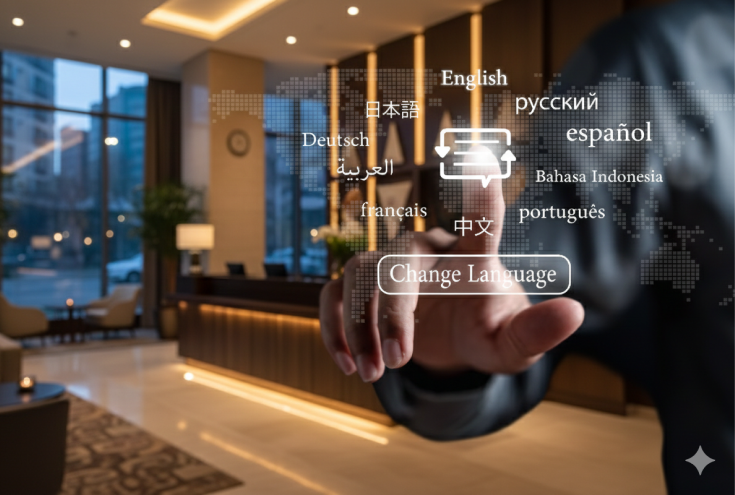
- If preferred language is unknown, default to English and offer a one-tap language selector
The goal is simple: remove language as a blocker so guests can act quickly and confidently—without staff needing to translate manually.
6) Focus on “spend per guest” personalization (the best path to revenue without raising rates)
If you want to grow revenue without raising rates, you need a stronger mix of:
- Upgrades
- Paid convenience (early/late)
- F&B and mobile ordering
- Wellness
- Experiences
But the key is doing it in a way that feels like hospitality—not e-commerce.
The most effective strategy in 2026: create a small set of “personalized bundles” that match why guests travel, and surface them through the right touchpoints.
Examples:
- Business Arrival Bundle: early check-in + express laundry + quiet-floor upgrade
- Family Comfort Bundle: crib + kids snacks + breakfast add-on
- Celebration Bundle: sparkling wine + late checkout + dinner reservation
These bundles work because they’re not random add-ons. They’re a personalized outcome: “We get why you’re here, and we made it easy.”
Key Takeaways For Every Hotelier in 2026
- Upsell and cross-sell without increasing staff workload by moving offers to self-serve digital flows and automating routing to ops teams.
- Drive more in-stay upsells with digital tools like guest messaging, mobile ordering, and digital compendiums that surface timely, relevant options.
- Automate upsell and cross-sell offers using triggers (timing), segmentation (guest type), and guardrails (inventory, frequency caps, stop conditions).
- Localize and auto-translate upsell messages with short templates, localized currency/time/units, and language preference detection or one-tap language selection.
- Increase hotel revenue without raising rates by focusing on spend per guest: upgrades, paid convenience, F&B, wellness, and experiences.
- Promote room upgrades and late checkout effectively via pre-arrival upgrade menus, digital check-in flows, and pre-departure inventory-aware prompts.
Increase upsells and ancillary revenue through digital touchpoints by connecting the journey end-to-end: pre-arrival → arrival → in-stay → pre-departure
Discover how Duve supports personalized journeys end-to-end, from pre-arrival offers to in-stay upsells and multilingual guest messaging.
Book a Demo
About the author
The Duve team comprises hospitality experts specializing in guest experience personalization, operational optimization, and innovative hotel technologies. With deep industry knowledge, they help hospitality providers elevate service, enhance satisfaction, and drive growth.