Hotels don’t struggle to identify leisure guests. They struggle to anticipate corporate guests.
Leisure travelers typically book their own stays. That means the hotel often receives richer context up front: who the guest is, what they selected, what dates they chose, whether they added breakfast, and sometimes even preference signals embedded in the booking path. Even when the data isn’t perfect, the intent is clearer because the buyer and the end user are the same person.
Corporate travel breaks that model.
For many business stays, the reservation is made on the guest’s behalf by a travel manager, an assistant, a corporate booking tool, or an agency. The result is a familiar problem: the hotel has a room night, a name, and a rate, but not the person behind it. Preference data is thin, arrival details are unclear, and the stay is full of assumptions. And when the experience is built on assumptions, upsells become generic and personalization becomes performative because the hotel is essentially guessing.
That’s why corporate guest experience and upselling can’t start with offers. It has to start with closing the data gap quickly, politely, and at the right moments.
Why differentiating corporate guests matters more than ever
Corporate guests evaluate hotels through a different lens than leisure guests. They aren’t chasing novelty. They’re chasing reliability. They have tighter time windows, less patience for friction, and higher sensitivity to anything that slows them down, like queues, unclear directions, or awkward calls to the front desk.
So if you treat corporate guests like leisure guests, you don’t just miss revenue. You create friction. And friction is expensive: it drives more service interactions, more complaints, and weaker repeat behavior with the account.
Differentiation doesn’t mean building a separate hotel within the hotel. It means designing an experience that recognizes a simple truth:
Corporate guests have fewer obvious signals, so the hotel has to earn them.
The strategy: stop selling, start meeting the guest at the right moments
The best corporate upsell strategy isn’t a bigger offer menu. It’s a better timing model.
A business traveler will rarely sit down and browse add-ons the way a leisure guest might. But they will respond when you show up at the exact moment a need becomes real.
Think about the corporate stay as a series of moments where the guest is either uncertain and needs clarity, busy and needs speed, or trying to control outcomes and will pay for certainty.
Those are the moments where you can learn preferences and offer relevant upgrades without it feeling salesy.
Moment 1: Pre-arrival is where you solve the data problem
For corporate stays, pre-arrival isn’t just welcome messaging. It’s your one clean opportunity to replace guesswork with real inputs before the guest is in motion.
What you need to learn is simple, but it has to be asked the right way. Corporate guests won’t answer a long questionnaire. They will answer a few high-value prompts if they clearly reduce friction.
Instead of asking “Any special requests?”, you’re better off asking questions that map directly to operational outcomes:
- How are you getting here (car, taxi or ride share, public transport)?
- What time do you expect to arrive, and how fixed is that?
- Do you need parking or transport support?
- Is this a quick overnight or a multi-day stay?
- What matters most this trip (quiet, fast check-in, workspace, early breakfast)?
This is where transport fits perfectly. Many corporate guests need a car, reliable ride share access, parking clarity, or a smooth transfer. If you wait until the lobby to discover that, it’s too late to make it feel seamless. If you capture it pre-arrival, transport becomes a service, not an upsell gimmick.
And once you have that answer, your offers stop being generic and start being logical:
- Need parking reserved?
- Want a scheduled transfer for a predictable arrival?
- Would an earlier check-in help given your meeting schedule?
It’s less upsell and more problems solved.

Moment 2: Arrival is about certainty, not options
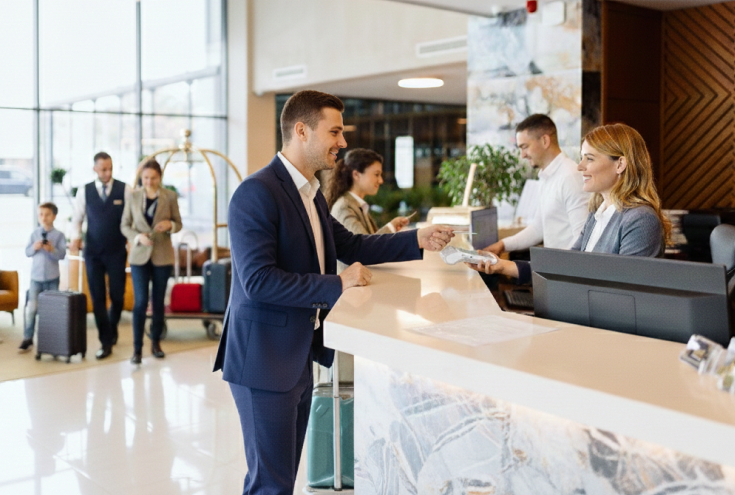
A corporate guest arriving after a flight, between meetings, or late at night is not looking for a menu. They’re looking for a fast path to the room.
This is why corporate upsells at arrival should be extremely focused: one or two offers that increase certainty, framed as time-saving and decision-light.
Two offers that consistently make sense in the corporate context:
- Guaranteed early check-in when travel timing is uncertain
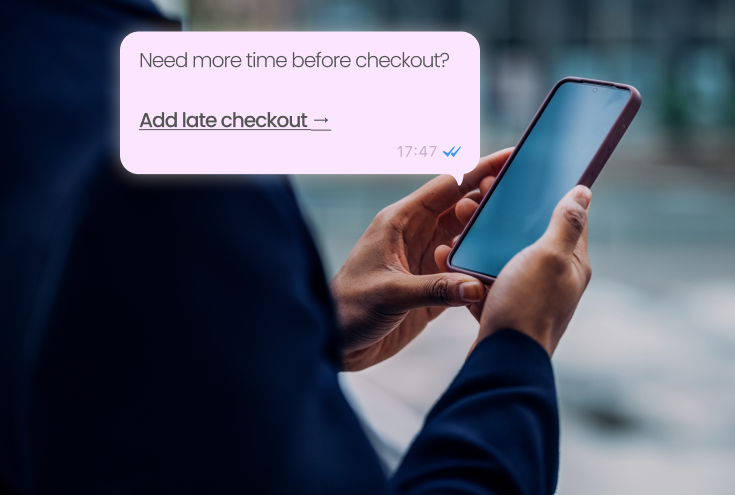
- Confirmed late check-out when departure is tied to meetings and flights
These aren’t “treat yourself” upgrades. They’re schedule control. That’s corporate value.
A subtle shift matters here. Instead of presenting add-ons as “extra,” present them as “locked-in.” Corporate travelers pay to remove variables.
Moment 3: The in-stay window is where you sell productivity and quiet
Corporate guests don’t buy “experiences” the same way leisure guests do. But they do buy anything that helps them perform, recover, and get through the trip with less effort.
This is where your strategy should pivot from amenities to outcomes:
If they’re in and out all day, housekeeping preferences and timing matter more than turndown theater. If they’re on day three of travel, laundry and pressing becomes a lifesaver. If they have early starts, breakfast isn’t a buffet fantasy. It’s “can I get food fast and expense it easily?” If they’re presenting tomorrow, quiet, sleep quality, and workspace become premium.
The best corporate upsells here are the ones that feel like operational support:
- Laundry and pressing with clear turnaround times
- Workspace upgrades, or simply confirming the room is set up to work
- Quiet room or higher floor positioning, even as a paid “guaranteed quiet” option if you can operationalize it
- Fast, predictable food options like grab-and-go or scheduled pickup
The theme is the same. Corporate guests pay for reliability.
Moment 4: Post-stay is where you earn repetition and make future upsells easier
For leisure guests, post-stay is marketing. For corporate guests, it’s admin.
If the folio is messy or unclear, you don’t just lose goodwill. You create friction with reimbursement, and friction reduces the chance they choose you next time even if the stay itself was fine.
This is also where you can build the corporate advantage over time. Every corporate stay should make the next one smoother. The best corporate personalization is iterative:
- Lock in room preferences
- Remember arrival patterns
- Save dietary and meal patterns
- Note transport behavior
- Keep invoice preferences consistent
When you do that well, your future upsells require less persuasion because they feel like continuity. “Same late check-out as last time?” is far better than “Would you like late check-out?”
What this means in practice: corporate upselling should feel like service design
If your corporate upsell strategy could be swapped into a leisure email without changing a word, it’s not corporate strategy. It’s a generic revenue play.
Corporate upselling works when it’s built on three principles:
Replace assumptions with inputs, because the booker is often not the guest.
Time offers around need moments, not marketing moments.
Sell certainty, speed, and support, not indulgence.
The best corporate offers aren’t luxuries. They’re control: arrival readiness, departure flexibility, quiet, food timing, and transport reliability.
Ready to stop guessing what corporate travelers want? See how Duve helps you capture preferences pre-arrival and deliver the right upsells at the right moment.
Book a Demo
About the author
The Duve team comprises hospitality experts specializing in guest experience personalization, operational optimization, and innovative hotel technologies. With deep industry knowledge, they help hospitality providers elevate service, enhance satisfaction, and drive growth.