Modern guests expect their arrival to be finished before they reach the property. No queue at the desk, no clipboard, no waiting while someone tracks down a reservation. Guest check-in behavior trends point to a clear shift, and Duve’s Online Check-in was built around that expectation: guests complete their personal details, payment, e-signature, and even room upgrades from their phone, days or hours before they ever walk in.
But “guests expect it” and “guests finish it” are two different things. A digital check-in link doesn’t guarantee a digital check-in. It guarantees an opportunity, and what a guest does with that opportunity, whether they finish the flow, when they start it, and how they got there in the first place, is where the real operational story lives.
We looked at check-in activity across the Duve platform to find out. If our guest messaging piece covered what happens once a guest is already talking to the hotel, this is the step before that: what happens in the minutes before arrival, when the guest is alone with their phone and a form. Five trends stood out.
Check-in completion rate
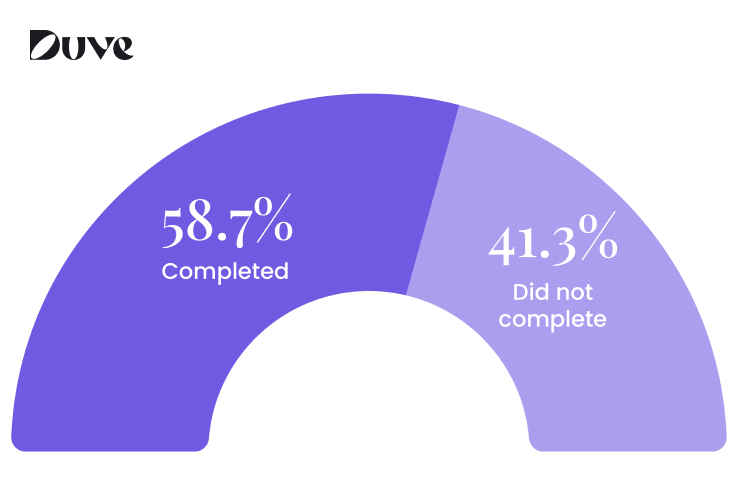
1. More Than Four in Ten Guests Who Start Never Finish
Across hotels on the platform, only 58.7% of guests who open the check-in flow actually complete it. Properties that configure the flow well typically land in the 60 to 80% completion range, so a meaningful share of hotels are landing below what’s achievable, guests who intended to check in from their phone and ended up standing at the front desk anyway.
That gap matters more than it looks. Every guest who abandons check-in doesn’t just skip a form, they walk into the lobby with their ID, payment, and registration card all still to be handled by a staff member who has other guests waiting too.
Tip: Completion rate is a configuration problem before it’s a guest behavior problem. Properties that exclude irrelevant steps by booking source (skip ID upload for Airbnb guests, skip payment for guests who already paid through an OTA) consistently see stronger completion than properties running the same flow for every guest regardless of how they booked. Every screen a guest doesn’t need to see is one less chance to lose them.
Where guests drop off, by screen
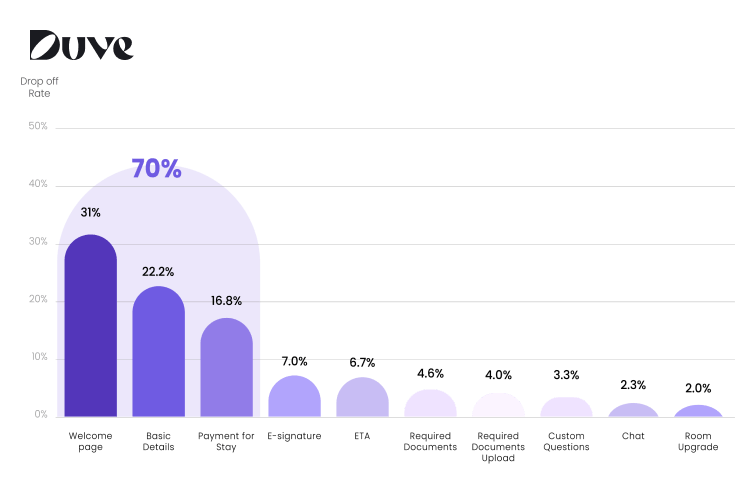
2. Guests Abandon Before They’ve Typed a Single Word
Of all the places guests drop off, the Welcome page accounts for roughly 31% on its own, more than any other single screen. Add the very next step, Basic Details, and just over half of all abandonment happens within the first two screens of the flow. Extend that to the third screen, Payment for Stay, and it climbs to nearly 70%.
This is a different failure point than most hotels assume. The instinct is to worry about the long steps: document upload, e-signature, the payment page. The data says the bigger problem is earlier and simpler than that. Guests are leaving before the flow has asked them for anything at all.
Tip: The Welcome page isn’t a formality, it’s the highest-risk moment in the entire flow. If the reservation preview is unclear, the branding feels generic, or the call to action isn’t obvious, guests bounce before the flow has a real chance to prove its value. For returning guests or narrow use cases, Quick Action Mode is worth using here too: send guests straight to the one step they need (just document upload, just signing) instead of routing everyone through the full sequence from the top.
Check-in start time by hour, UTC
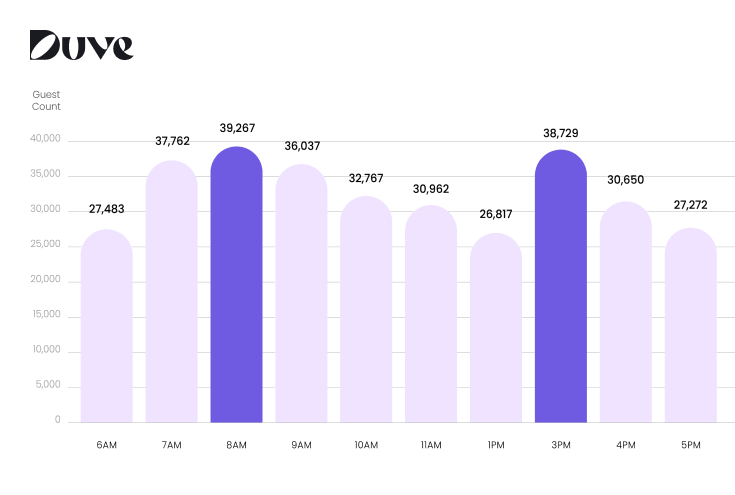
3. Guests Check In Twice a Day, Not Once
Guest messaging, from our earlier data, spikes once around 2pm UTC and tapers off from there. Check-in behaves differently. It clusters into two distinct windows: one running roughly 7 to 10am, a second building again around 3pm UTC, with a visible dip through the late morning in between.
Guests are starting check-in over morning coffee and picking it back up in the afternoon, not at one predictable hour of the day. That’s a meaningfully different rhythm than the one most front desk staffing plans are built around.
Tip: If front desk staff review submitted check-ins as they come in (the most common setup once Online Check-in is live), coverage needs to account for both windows, not just the one that feels intuitive. A single morning review pass will miss the entire afternoon batch, which means those guests’ approvals, and any issues in what they submitted, sit unresolved for hours.
Days before arrival that guests complete check-in
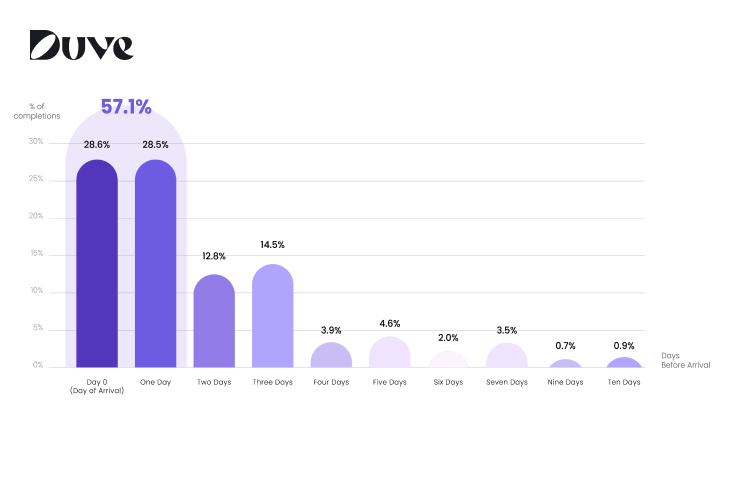
4. Check-In Is Still a Last-Minute Habit, Even When It’s Digital
Among guests who do complete check-in, 57% do it within 24 hours of arrival, split almost evenly between the day of arrival and the day before. Moving the process online didn’t change when guests get around to it. It only changed what that last-minute action looks like.
This is worth sitting with. The entire premise of online check-in is removing the guest’s dependency on being physically present. And yet guest behavior around timing barely moved. Given the choice to check in a week early or the night before, most guests still choose the night before.
Tip: The last reminder before arrival is doing more work than most invitation sequences give it credit for. If a property’s reminder schedule front-loads messages early (booking confirmation, then a reminder a week out) and tapers off close to arrival, it’s pulling back right when most guests are actually ready to act. A well-timed reminder sent within that final 24-hour window will outperform an earlier one that arrives before the guest is paying attention.
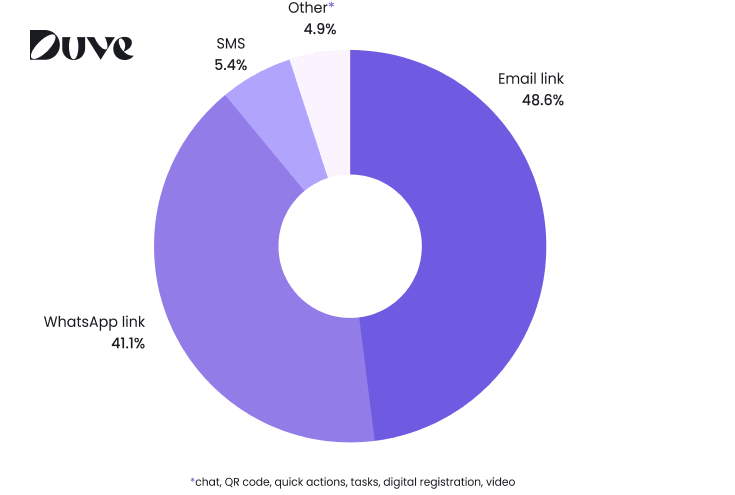
How guests enter the check-in flow
5. Email Still Wins the Handoff, but Not by Much
When guests enter the check-in flow, 48.6% arrive through an emailed link, 41.1% through WhatsApp, and just 5.4% through SMS. Email edges out WhatsApp, but the margin is narrow enough that neither channel can be treated as the default the way WhatsApp was for in-stay messaging.
That’s a distinction worth making clearly: the channel guests prefer for talking to a hotel and the channel that actually gets them into check-in are not the same channel, and treating them as interchangeable risks losing a large share of guests before they’ve even started.
Tip: Sending the check-in invitation on only one channel is a real gap, not a minor one. With a split this close, an email-only or WhatsApp-only sequence is likely losing close to half its potential audience before a guest ever sees the Welcome page. Sending on both, rather than picking one, is the safer default until a property has its own channel data to say otherwise.
Why This Matters
Online check-in was supposed to remove friction from arrival, and for the guests who finish it, it does exactly that: no queue, no paperwork, no waiting. But the data shows the flow itself carries its own friction. An early, steep drop-off. A completion rate sitting below what well-run properties typically achieve. And guest habits, checking in at the last minute, favoring WhatsApp almost as much as email, that don’t always match how a property’s invitation sequence is actually built.
The properties getting the most out of digital check-in aren’t the ones that turned it on once and left it alone. They’re the ones treating invitation timing, channel mix, and step order as something to keep adjusting as guest behavior shows itself in the data.
Duve's Online Check-in gives properties control over every part of that flow: which steps appear, in what order, through which channel, and for which guests. Book a demo to see how it's configured for properties running completion rates above the platform average.
Book a Demo
About the author
The Duve team comprises hospitality experts specializing in guest experience personalization, operational optimization, and innovative hotel technologies. With deep industry knowledge, they help hospitality providers elevate service, enhance satisfaction, and drive growth.