



How We Built a Hotel AI Messaging Agent for the Modern Front Desk
 By Duve Team
By Duve Team
By Duve Team Stay updated on the latest Guest Experience and Hospitality Tech updates.
There’s a moment that every hotel operator knows. It’s 11pm. The front desk team has been on since early morning. A guest sends a message asking about nearby restaurants. Another asks how to access the pool. A third has a birthday celebration request. Somewhere in that message is an opportunity the property can’t afford to miss.
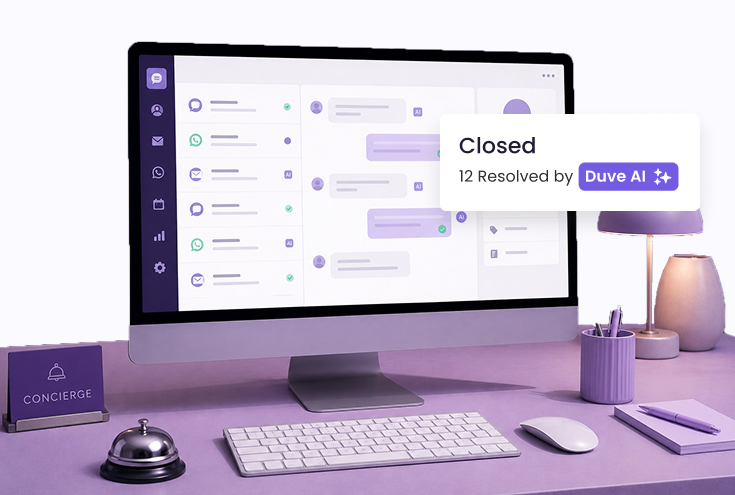
DuveAI, the hotel AI messaging agent we built at Duve, exists because of that moment, and the thousands like it that play out across hotel properties every day. The front desk is one of the most operationally loaded roles in hospitality. It’s not just a communication channel. It’s the nerve center of the guest experience: the place where expectations are set, problems get solved, and revenue opportunities are either captured or lost. And it operates under constant pressure: high message volume, unpredictable demand, and guests who expect answers in minutes, not hours.
We believed that a well-built AI agent could meaningfully reduce the operational burden on front desk teams, not by replacing the human judgment that hospitality demands, but by handling the predictable, high-frequency work that consumes time without requiring it.
But there was a second belief behind this, one we felt was underrepresented in how the industry was thinking about AI. A recent Skift analysis pointed out that most AI in hospitality is deployed to cut operational costs, not to generate revenue. We think that framing leaves money on the table. Guest chat is one of the highest-intent touchpoints a hotel has. Every conversation is a moment where the right response, or the right offer, can directly impact revenue. We built DuveAI to do both.
The goal wasn’t efficiency for efficiency’s sake. It was to give hotel teams back the cognitive space to do what they do best: build genuine connections with guests, manage the unexpected, and focus on the interactions where their expertise actually matters.
Not in the way most people mean the word. A typical hotel chatbot answers from a fixed script and does not know who it is talking to. DuveAI is connected to the property’s reservation system, past guest interactions, and CRM, so it answers as if it already knows the guest, because it does. It also knows the limits of what it should handle on its own, and hands a conversation to a human the moment the situation calls for it.
So the honest answer is that DuveAI does the job people hope a hotel chatbot will do, while avoiding the part that makes guests distrust chatbots: generic, context-free replies.
Before writing a single line of code, we analyzed 60,000 real guest conversations across Duve’s hotel network. We were looking for patterns: the recurring questions, the common request types, the language structures that would let us build a hotel AI messaging agent that felt consistent and reliable.
What we found instead was organized complexity.
A guest messaging a ski resort in Japan communicates nothing like a guest at a luxury boutique hotel in Chicago. The tone, the expectations, the cultural context, the question types. All of it varies not just by market, but by property type, guest segment, and even time of day. There is no universal guest voice. And that finding fundamentally shaped how we built the agent.
“When we dug into the data, we realized there was no single pattern to build around,” said Daniel Antebi, AI Engineer at Duve. “The guests are so different from property to property that the real challenge became figuring out where an AI could actually be confident, and where it needed to step back. That is what drove the whole architecture.”
That analysis of 60,000 conversations is the foundation of DuveAI, and it is the part competitors cannot copy with a feature. The question it forced was simple: how does one agent speak meaningfully to all of those guests? The answer was not something more generic. It was something more principled.
Getting this right requires solving for things that aren’t obvious from the outside.
Speed and accuracy were non-negotiable. Guests expect fast responses, and a slow or incorrect AI answer is worse than no AI at all. The agent had to be reliable enough that hotels could trust it to represent their brand at any hour, in any language.
Knowing its own limits was equally important. The agent is designed to handle what it can handle well, and to seamlessly involve a human when the situation calls for it, integrating directly with Duve’s guest messaging platform so that transition is invisible to the guest. Minimizing hallucination risk wasn’t a nice-to-have; it was a core design requirement.
The agent also needed to do more than answer questions. It had to recognize opportunity within a conversation and surface the right offering at the right moment, contributing to revenue without feeling transactional. This capability sits at the center of Duve’s broader hotel upsell tools, and here it operates as a natural extension of the guest interaction rather than an add-on.
Critically, every response is personalized. The agent draws on real-time data about the guest, from the reservations system, past interactions, CRM data, and more, so responses aren’
Supporting all languages was a requirement, not a feature. Hospitality is global, and guest communication reflects that. The agent meets guests where they are.
We launched the agent in March, and the performance since has validated the core assumptions behind our approach.
The volume of guest messages handled by the AI has grown 32.6% since launch, with up to 85% of guest messages now handled automatically, without requiring any action from a human team member. That translates directly into front desk capacity recovered for higher-value work.
The impact on team workload is significant. Since launch, there has been a 76% reduction in messages requiring human handling. Front desk teams are spending less time in the queue and more time on the interactions that genuinely need them.
Guest response is equally strong. 90% of guests report positive sentiment after an AI interaction, and average response time has dropped from 49 minutes to 28 seconds. For an industry where speed and tone define the guest experience, that’
On the revenue side, upsell engagement has grown 190% since April, with hotels seeing a 20% increase in upsell revenue directly attributed to the agent. As STR’s hospitality benchmarking data consistently shows, ancillary revenue is one of the highest-leverage opportunities available to hotel operators, and the agent is now actively contributing to it at scale. Hotels using Duve’s digital guest experience tools alongside the agent are seeing the compounding benefit of a connected platform rather than a standalone add-on.
One of the decisions we’re most deliberate about is how we’ve structured the agent for the future.
AI technology is evolving faster than any product roadmap can fully anticipate. So rather than building something optimized for today’s models, we’ve built an architecture designed to improve as the underlying technology improves. “The agent is already strong enough that as the technology gets better, it gets better with it,” Antebi said. “We didn’t want to build something we’d have to rebuild in two years. The architecture is designed to age well.”
We’re also thinking carefully about personalization at the property level and the guest level. The 60,000-conversation analysis made clear that no two hotels are the same. The next step is giving hotels the ability to configure their own agent persona: the tone, the communication style, the approach that feels right for their brand and their guests. A five-star urban property and an independent boutique resort shouldn’t sound identical, and they won’t have to. A honeymoon couple won’t get the same recommendation as a business traveler.
The AI Reception Agent is the first of what we’re building. Next on the roadmap is a DuveAI Booking Agent, a conversational AI that lives on the hotel’s website and allows guests to explore availability and book a room entirely through natural conversation, without navigating a traditional booking engine. It’s a fundamentally different way to think about the hotel website as a sales channel
Together, these agents are designed to be a foundation: something that proves what’s possible when AI is applied thoughtfully to hospitality operations, with real data behind the decisions and real constraints built into the design.
What is a hotel AI messaging agent?
A hotel AI messaging agent is software that automatically handles guest communication on behalf of a hotel, responding to inquiries on WhatsApp, SMS, email, and OTA chat channels without requiring front desk staff to reply manually. DuveAI is Duve’s hotel AI messaging agent, built specifically for hospitality. It draws on live PMS data and guest reservation context to send personalized, accurate responses in over 100 languages, around the clock.
What kinds of guest questions can DuveAI handle?
DuveAI handles the high-frequency, predictable inquiries that typically consume front desk time: check-in and check-out details, pool and gym hours, parking instructions, restaurant recommendations, late checkout requests, and more. When a message falls outside what the agent can handle confidently, it escalates to a human team member with the full conversation context already loaded.
How does DuveAI personalize responses for each guest?
Each DuveAI response is generated using real-time data pulled from the hotel’s PMS, including reservation status, loyalty membership, booking source, and guest preferences. A returning guest is recognized as one. A guest with a special occasion in their booking receives a different experience than a standard business traveler. Responses reflect the context of that specific guest, not a generic template.
What communication channels does DuveAI support?
DuveAI works across the channels guests already use: WhatsApp, SMS, in-app chat, and OTA messaging platforms including Airbnb and Booking.com. Guest messages are centralized in Duve’s communication hub, so the hotel team has full visibility regardless of which channel the guest used to reach out.
Does DuveAI support multiple languages?
Yes. DuveAI automatically detects the guest’s language and responds accordingly, with support for over 100 languages. No manual configuration is required. For properties in international destinations or urban markets with diverse guest profiles, this happens automatically on every conversation.
How does DuveAI help with upselling?
DuveAI is designed to recognize upsell opportunities within a guest conversation and surface the right offer at the right moment, whether that is a room upgrade, a spa package, a late checkout, or a dining reservation. Since launch, upsell engagement has grown 190% and hotels using DuveAI have seen a 20% increase in upsell revenue directly attributed to the agent. This capability integrates with Duve’s broader upsell tools, so it operates as a natural part of the guest interaction rather than an add-on.
What happens when DuveAI cannot answer a question?
When DuveAI detects that a message requires human judgment, because of complexity, an unusual request, or the tone of the conversation, it escalates to the front desk team with the full conversation context already loaded. The guest receives an acknowledgment that their request has been forwarded. The handoff is designed to be invisible to the guest and efficient for the team.
Does DuveAI integrate with hotel PMS systems?
Yes. DuveAI connects directly to the hotel’s PMS, which is what enables personalized, context-aware responses. Duve integrates with over 150 partners including all major PMS providers, OTAs, payment service providers, and digital key platforms. This connectivity is what separates a genuinely useful AI agent from one that can only answer from a static knowledge base.
How accurate is DuveAI, and what prevents it from giving guests wrong information?
Minimizing the risk of inaccurate responses was a core design requirement. DuveAI is built to recognize the boundaries of its own confidence. When it is not certain of the right answer, it does not guess, it escalates. Every response is grounded in live property data and reservation context, which significantly reduces the risk of inaccurate information reaching guests.
The goal was never to automate the guest relationship. It was to protect it, to ensure that the moments requiring human warmth and judgment get exactly that, while everything else gets handled with the speed, accuracy, and consistency that guests increasingly expect. According to Statista’s global hospitality data, guest satisfaction scores are increasingly tied to response speed and personalization, making the case for intelligent automation stronger than ever.
What we’ve built is a version of the front desk that doesn’t sleep, doesn’t get overwhelmed, and never stops looking for an opportunity to serve the guest better. That’s what we set out to build. And based on what we’re seeing, it’s working.
Ready to see it in action? Request a demo of DuveAI and explore what it could do for your property.