


Luxury Guest Experience: How to Create a 5-Star Feeling in Every Hotel
 By Duve Team
Stay updated on the latest Guest Experience and Hospitality Tech updates.
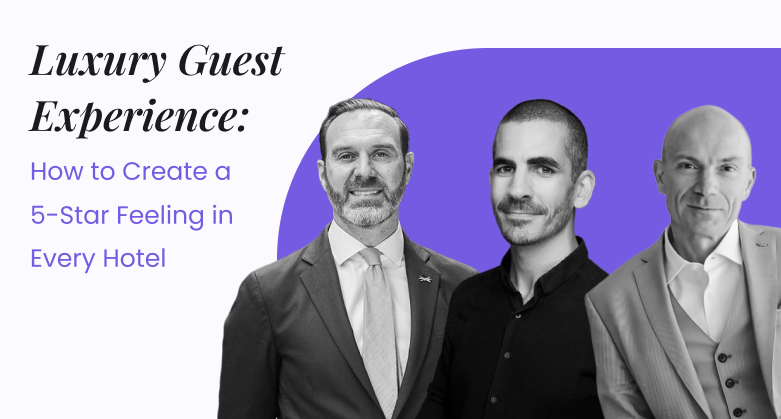
The definition of luxury hospitality is shifting. No longer reserved for an elite few, luxury today is about making every guest feel special through personalization, seamless service, and genuine emotional connection. This was the central theme of Duve’s recent webinar, Luxury Guest Experience: How to Create a 5-Star Feeling in Every Hotel.
The session brought together three leaders with very different perspectives:
Together, they unpacked how hotels of all sizes can deliver five-star moments, the role technology plays in enabling them, and where luxury hospitality is heading next.
The panel began by reflecting on how guests define luxury in 2025. The baseline expectations, comfortable rooms, hot showers, no mistakes, are givens. What distinguishes luxury is the ability to deliver something beyond the basics, something memorable that creates an emotional imprint. Guests expect more than consistency; they expect moments they will never forget.
Jeremy Atlan explained that the real difference between luxury and non-luxury is that luxury guests want to feel seen and special, not treated as just another booking. Personal touches, from pre-arrival communication to how staff anticipate needs, are what elevate the experience.

CBDO
Duve
While every stage of the guest journey matters, the panel agreed that check-in is the decisive moment. A flawless arrival can set a positive tone for the entire stay, while a delayed room or clumsy welcome can sour the guest’s perception before it even begins.
The discussion highlighted how digital pre-check-in has transformed this stage. By knowing when guests will arrive, hotels can better align housekeeping schedules and avoid awkward delays. This ensures the first moments are about warmth, not paperwork, giving staff time to connect personally rather than chase logistics.

General Manager
Sofitel Mexico City Reforma
Technology is now inseparable from the guest experience, but the panelists stressed it should never be about adding gadgets for the sake of novelty. Instead, luxury hotels must adopt tech that removes friction and creates a seamless journey.
Eugene Leonard reflected on the industry’s evolution, from fax machines to today’s mobile-first communication. Guests now expect digital convenience to be embedded in every interaction, from booking and social media engagement to in-room dining. Importantly, tech should simplify, not overwhelm: wireless charging, intuitive Bluetooth connections, or an easy way to order food are more meaningful than complex touch panels.

General Manager
Hotel Cafe Royal
A recurring theme was personalization, not as a buzzword, but as a practical strategy to make guests feel uniquely cared for. Both Sylvain and Eugene shared examples of how small gestures, enabled by data, create unforgettable memories.
At Sofitel Mexico City Reforma, pre-arrival questionnaires powered by Duve capture details that PMS systems miss: children’s names, anniversaries, even pets. With this knowledge, the team can prepare cookies with a dog’s name, or teddy bears embroidered for children. At Café Royal, Eugene described how staff greet young guests by name, skipping queues and presenting personalized gifts upon arrival.
Jeremy emphasized that technology is what makes this personalization scalable, even for hotels without large teams.
CBDO
Duve
One of the paradoxes luxury hotels face is how to embrace digital tools without losing human warmth. For today’s travelers, mobile messaging is second nature. Nearly half of Café Royal’s guests now communicate through WhatsApp-style channels. Quick, convenient answers, whether booking yoga at midnight or confirming spa hours, have become expected.
But, as Sylvain pointed out, technology should take care of the functional details, freeing staff to focus on the emotional side of hospitality. Rather than answering routine questions about opening hours, employees can use that time to connect more deeply with guests.
General Manager
Sofitel Mexico City Reforma
The panel also discussed how technology not only improves the guest journey but also reduces operational friction for staff. Too often, hotels rely on dozens of disconnected systems, forcing teams to spend more time in front of screens than with guests.
Eugene noted that when technology systems integrate properly, staff spend less time on repetitive admin and more time on what really matters, making guests happy. The less time employees spend “swivel-chairing” between platforms, the more they can engage meaningfully with guests.
General Manager
Hotel Cafe Royal
Is luxury defined by lavish surroundings or by the emotions evoked? The panelists agreed: physical beauty matters, but it is the emotional experiences that linger.
Sylvain shared the story of a couple dining at Sofitel before the birth of their first child. A waitress surprised them with a card signed by staff and a small toy for the baby, a gesture that cost almost nothing but created a priceless memory. Eugene recalled a moment at Four Seasons Maldives when a staff member suggested a playful sand crab race on the beach, a memory still vivid years later. These personal touches, not chandeliers or marble lobbies, are what define true luxury.
General Manager
Sofitel Mexico City Reforma
Looking ahead, the panelists saw luxury hospitality evolving in three key ways. First, responsible luxury and sustainability will become non-negotiable, as guests expect brands to align with their values. Second, technology will continue to consolidate and simplify, not more buttons, but more ease-of-use. And third, AI will reshape how hotels operate, giving staff “superpowers” to deliver personalization at scale.
Jeremy described AI as a multiplier that can handle repetitive tasks while still tailoring responses to each guest’s profile, freeing staff to focus on creating memories. But the panel was clear: no matter how advanced technology becomes, it must serve human connection, not replace it.
CBDO
Duve
The webinar made one truth clear: luxury is no longer about exclusivity or excess, it’s about personalization, seamlessness, and emotion. Technology enables hotels to remove friction, anticipate needs, and scale personalization. But it is the people, front desk agents who know a child’s name, waiters who create surprise moments, managers who listen to guests’ stories, who transform a stay into a lasting memory.
In an era where every hotel can compete on design, luxury will be defined by those who compete on emotional impact.