It is 11:40pm. A guest who has been travelling for fourteen hours finally got to your hotel, and is now waiting another 20 minutes in line to get a piece of plastic. In most hotels, some version of that plays out every week.
With Wallet Keys, you can now simply send guests their room key straight to their Apple or Google Wallet for instant tap-to-enter access, removing the wait for your guests, and the pressure on your team.
What are wallet keys for hotels?
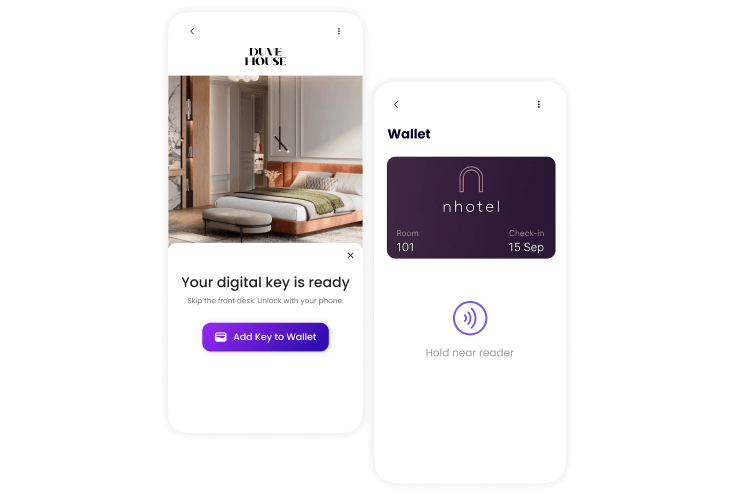
A wallet key is room access that lives in the guest’s Apple Wallet or Google Wallet, next to their boarding pass and payment cards. The guest holds the phone to the reader and the door opens. No app download, no pairing screen, no account to create.
It works via NFC, the tech behind contactless payment. The credential is written into the phone’s Secure Element, a hardware chip isolated from the operating system. That is why the tap is fast and needs no network connection: the phone is not fetching anything at the door, it is presenting a credential it already is connected to. A tap completes in roughly 500 milliseconds, and is branded to your property name, the room number, the stay dates, and with potential of additional tailoring such as membership type, and more.
Three things change for the property.
The first is arrival: An already checked-in guest can move straight up to their room, creating a memorable experience that can make your hotel feel one step ahead.
Second, work comes off your team. Encoding, re-encoding, printing a replacement at midnight: a lot of that goes away, and thousands of plastic cards a year stop being printed and thrown out.
Third, none of it rests on a download. And because the key is not an app, it works for the guest who would never have installed one, and it carries on working for hours after the battery gives up.
Wallet key vs mobile key vs pin key: what actually differs
“Digital room keys for hotels” covers three technologies. An app-based mobile key runs over Bluetooth and needs the hotel’s app installed. A web PIN key sends the guest to a keypad code. A wallet key puts an NFC credential in the phone’s own wallet. Five differences decide what actually happens when the guest reaches the room.
The download
- Wallet key: none. The key adds itself in a tap, into the wallet the guest already uses.
- App-based mobile key (BLE): required. The app is not an extra, it is the credential. The key has no life outside it, so the guest has to install, sign in and keep it on the phone all stay.
- PIN code: none, but the guest has to receive the code and remember it.
Asking someone to install software for a two-night stay is where most digital key programmes lose their audience.
Speed at the door
- Wallet key: around half a second. One tap, screen off.
- App-based mobile key (BLE): 5 to 10 seconds. The phone has to wake, the app has to come forward, and a Bluetooth session has to negotiate with the reader. Android compounds it by suspending backgrounded apps, so the app often cold starts while the guest waits.
- PIN code: as long as it takes to find the code and type it correctly, which is rarely first try after a long flight.
The lock is not the bottleneck. The phone is.
Offline and dead battery
- Wallet key: works for 5 additional hours for Apple keys. Nothing is fetched at the door, and on iPhone the credential stays presentable in Power Reserve for roughly five hours after the battery shows empty. Not available for Google keys.
- App-based mobile key (BLE): fails. The key needs a live app and a live radio, so it dies when the operating system suspends the app or the battery goes.
- PIN code: works with no phone at all, which is its one real advantage over both.
Where the credential lives
- Wallet key: the Secure Element, a hardware chip on the device isolated from the operating system.
- App-based mobile key (BLE): inside the hotel app, against a server session.
- PIN code: in the lock’s code table, and in the guest’s memory or an old message thread. A code that has been shared or screenshotted cannot be un-shared.
Adoption in practice
- Wallet key: lock vendor dormakaba reports up to 80% of eligible guests adding the key.
- App-based mobile key (BLE): trade coverage from Hotel Facility Guide puts mature programmes at 25% to 40%.
- PIN code: high compliance, since there is nothing to install, but no branding in the guest’s hands and no clean revocation trail.
Strip out the download and the wake-up, and what the guest feels is a door that opens as fast as a contactless payment.
How a room key gets into Apple Wallet
Provisioning starts in your PMS. Once a room is assigned and the guest has completed check-in, Duve requests a credential from your lock vendor’s key management system and returns an “Add to Apple Wallet” action. One tap writes the key to the Secure Element.
From there, Express Mode does the work: no waking the phone, no Face ID, no selecting the pass. The key can also connect to an Apple Watch.
The part worth understanding as a buyer is the Credential Manager model. Getting a room key into Apple Wallet used to require the hotel’s own app as the provisioning vehicle, and that is what capped app-based programmes. Under the Credential Manager model, a platform holds the relationship between the reservation, the lock system and the wallet, and hands the credential to the guest directly. Duve operates on this model, so the guest installs nothing and a hotel no longer needs an app to run a key programme.
And on Android: room keys in Google Wallet
Google Wallet hotel keys work on the same principle: NFC credential, hardware-backed storage, tap to open, no app. Duve provisions to both wallets through the same flow, so the journey your team designs does not fork by handset.
The Android side is younger. Fewer lock platforms have shipped Google Wallet support, and reader firmware requirements can differ. Club Quarters runs Google Wallet keys at every property, but the ecosystem lacks Apple’s breadth. So ask your lock partner not “do you support wallet keys” but “do you support both wallets, like Duve does.”
What your property needs to run wallet keys
Four dependencies:
- Locks with NFC readers that support the wallet protocols. The gating item. Mag-stripe locks will not do it, and neither will some older RFID readers. In many estates the fix is a firmware update, not new hardware, but only your lock partner can confirm your reader generation. Vingcard, dormakaba and Salto have shipped wallet-capable lines Confirm your own reader generation with your lock partner.
- A PMS that exposes reservations and room assignment in real time. The credential is minted against a specific room for a specific window. Your provider needs to connect to your existing PMS. Duve supports all major PMS, check our integration page to find yours.
- The credential rail from your lock vendor. Their key management service mints the credential. Duve sits above it, requesting keys, setting validity windows and revoking at check-out. You are not replacing your lock system.
- Release workflow. A key can only be issued once checked in and conditions are met. Most providers offer one release flow for wallet keys. Make sure they fit your requirements. Duve supports flexible workflows from pre-arrival links sent, QR code scanning on-site, to manual release and tailored flows depending on guest type or other conditions.
Then there is what your team owns: brand assets for the pass, which sits in the guest’s wallet all stay and is a visible piece of hotel branding; guest contact data clean enough to reach people, because a key that cannot be delivered is not a key; a short front desk briefing on the fallback path; and an agreed process for mid-stay room changes. Existing clients activate digital keys through their Customer Success Manager.
What adoption actually looks like
Guests want this. Hotel Tech Report’s State of Guest Tech Report found 60% of guests prefer digital keys to traditional keycards, and a Mews survey put the share of travellers who would skip the front desk at 70%. Yet CNBC reported only 14% of guests actually use a digital key.
That gap is the story of this category, and it is not a demand problem. App-based key programmes sit at 25% to 40% adoption among eligible guests at mature programmes, according to Hotel Facility Guide, for a reason that has nothing to do with the key: you are asking a guest to download an app for a two-night stay before they have any reason to trust it. Most decline.
Remove the download and the numbers move. At Resorts World Las Vegas, 80% of eligible guests added the wallet key at check-in, as reported by Skift. Across Duve properties, 71% guest adoption where Duve delivers the key [CLEARANCE PENDING].
Be precise about what those figures prove. Resorts World is one property, a large resort with a tech-forward guest profile and a promoted launch, and “eligible guests” counts those who reached provisioning. It is strong evidence that friction, not appetite, was the constraint, not a number every property should expect to reproduce. The Duve figure spans a wider mix, measured where the key is actively delivered into a channel the guest already uses. Neither tells you what happens if you switch wallet keys on and do nothing to promote them. The barrier was never the tap.
Guests want this. Hotel Tech Report’s State of Guest Tech Report found 60% of guests prefer digital keys to traditional keycards, and a Mews survey put the share of travellers who would skip the front desk at 70%. Yet CNBC reported that only 14% of branded hotel guests actually use a digital key.
That gap is the story of this category, and it is not a demand problem. App-based key programmes sit at 25% to 40% adoption among eligible guests at mature programmes, according to Hotel Facility Guide, for a reason that has nothing to do with the key: you are asking a guest to download an app for a two-night stay before they have any reason to trust it. Most decline.
Remove the download and the numbers move. At Resorts World Las Vegas, Skift reported the launch of a wallet-based room key that requires no hotel app, and Dormakaba later reported that 80% of guests who completed check-in added a digital key. Across Duve properties, 71% guest adoption where Duve delivers the key.
Be precise about what those figures prove. Resorts World is one property, a large resort with a tech-forward guest profile and a promoted launch, and “eligible guests” counts those who reached provisioning. It is strong evidence that friction, not appetite, was the constraint, not a number every property should expect to reproduce. The Duve figure spans a wider mix of costumers and hotels, measured where the key is actively delivered into a channel the guest already uses. Neither tells you what happens if you switch wallet keys on and do nothing to promote them. The barrier was never the tap. It is the download and the lack of sending the key.
Helps Fulfill Our Property Potential: It's excellent because you don't have to carry a card to open the room door or a wallet, the phone is always with us.
Infrastructure Manager
Vert Hotels
Getting the key into the guest’s hands
Most of this category explains what a wallet key is. Very little explains how it reaches the guest, which decides whether any of this happens at your property.
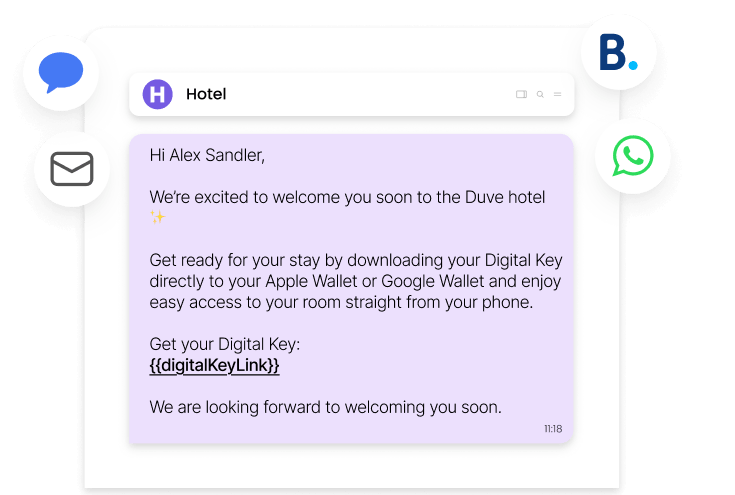
Duve delivers the key natively, single vendor, hotel-branded, across the channels guests already use: WhatsApp, email, SMS, Booking.com chat, WeChat and more. A guest who booked through an OTA has never seen your email domain. Reaching them in the thread they booked in, through the Communication Hub, is the difference between a key that gets added and one that sits unopened in a promotions folder.
There are three set deployment models, and most properties run more than one, plus customizations if wanted. Pre-arrival and automated is the default,a link is sent via Whatsapp to download the key, so the guest lands with the key in their wallet. On-site QR with real-time validation covers walk-ins, same-day bookings and anyone who skipped check-in. Staff-initiated is one click from the Communication Hub, for the guest who calls at 11pm.
The key and workflow can be personalised by brand for groups running multiple flags, by membership, by booking source, and more. Paired with the guest app, it becomes an entry point to the rest of the stay.
What happens when the phone battery dies
This is the first question hoteliers raise, consistently, in almost every conversation about wallet keys.
On iPhone, the key keeps working in Power Reserve for roughly five hours after the battery shows empty. The phone holds back power to keep NFC credentials presentable, the same mechanism that keeps transit passes working on a flat handset. That makes a wallet key more reliable at the door than an app-based key, which fails as soon as the operating system suspends the app. On Android, behaviour varies by manufacturer.
And the plastic card fallback never goes away. Staff can issue a plastic card or push a fresh key in one click. Wallet keys reduce how often that conversation happens, they do not remove the option.
Less work at the desk, less plastic in landfill
Plastic keycards fail at a rate most properties have stopped noticing. OpenKey puts the share of magnetic keycards that demagnetise or malfunction at 15% to 20%, and a failed card often sends a guest back to the desk.
PrintPlast, a keycard manufacturer, estimates that a 200-room hotel runs through 8,000 to 15,000 keycards a year, and that the industry uses roughly 6 billion cards annually across around 700,000 hotels, with under 1% recycled and PVC taking 300 to 500 years to break down. Duve properties are printing roughly 15K fewer keycards a year.
The operational side compounds it. Stayntouch cites Cornell research showing that U.S. guests have a five-minute tolerance for check-in waits, with satisfaction dropping 47% once that threshold is exceeded; the corresponding threshold for Canadian guests is seven minutes. TrueOmni separately reports traditional check-ins taking 7 to 10 minutes during compressed arrivals and says digital check-in can reduce check-in and checkout time by 4 to 6 minutes. AHLA reported that 76% of surveyed hotels faced staffing shortages in May 2024, falling to 65% by year-end 2024. Taking encoding, re-encoding and card replacement out of arrival gives a short-staffed desk its attention back.
Wallet keys FAQ
What are wallet keys for hotels? Room access stored in a guest’s Apple Wallet or Google Wallet. The guest taps their phone on the door reader to open the room, no app download.
Do guests need to download an app? No. The credential is added straight to the phone’s wallet from a link the hotel sends. That is the main difference from app-based keys.
How does a hotel room key in Apple Wallet work? After check-in and room assignment, the hotel’s platform requests a credential from the lock system and sends an “Add to Apple Wallet” action. The key sits in the Secure Element and opens the door over NFC via Express Mode, no Face ID needed.
Do Google Wallet hotel keys work the same way? Yes, on the same NFC principle. Lock-platform support is less widespread on Android than iOS, so confirm both wallets with your lock partner.
What happens if the guest’s phone battery dies? On iPhone the key works in Power Reserve for roughly five hours after the battery shows empty. On Android, dead battery access is generally not supported.
Do we need to replace our door locks? Often not, but it depends on your reader generation. You need NFC readers that support the Apple and Google wallet protocols. In many estates that is a firmware update, and mag-stripe and some older RFID readers will need replacing. Your lock partner can confirm.
How do guests receive their key? Through WhatsApp, email, SMS, Booking.com chat, . Expedia, WeChat and more: automatically before arrival, via an on-site QR code, or with one click from your team. Plastic cards stay available.
Want to give your guests a better way in? Book a demo to see Wallet Keys in action, and we’ll walk you through what your hotel needs to get started.
Give your guests a better way in
About the author
The Duve team comprises hospitality experts specializing in guest experience personalization, operational optimization, and innovative hotel technologies. With deep industry knowledge, they help hospitality providers elevate service, enhance satisfaction, and drive growth.